
Guangxuan (GX) Xu
Principal Research Scientist & Engineering Lead, Lightwell AI Harness
Boston, MA
About
I am a Principal Research Scientist and the Engineering Lead for the Lightwell AI Harness at Red Hat. My current work centers on harness engineering — designing the agent runtime, evaluation loops, and self-improvement machinery behind Red Hat's Lightwell initiative — together with the research that underpins it: inference-time scaling, AI for cybersecurity, and recursive self-improvement. The harness is built on Refactory, the self-evolving agent engine that powers Lightwell, which I help steward as a core maintainer.
Before Lightwell, I was a Founding Engineer on the Red Hat AI Innovation team and a founding member of InstructLab, the open-source platform for customizing large language models. Earlier still, at IBM Research, I developed preference-tuning and alignment methods for the Granite model family. I hold an MS in Computer Science from UCLA and a BA from Wesleyan University, and my work spans publications at NeurIPS, ICLR, ICML, ACL, and EMNLP — see my Google Scholar for details.
Awards & Honors
- 2026 IBM Tech 2026 — Recognized among the top 1,000 of IBM's ~300,000 employees worldwide for outstanding technical contribution to the company.
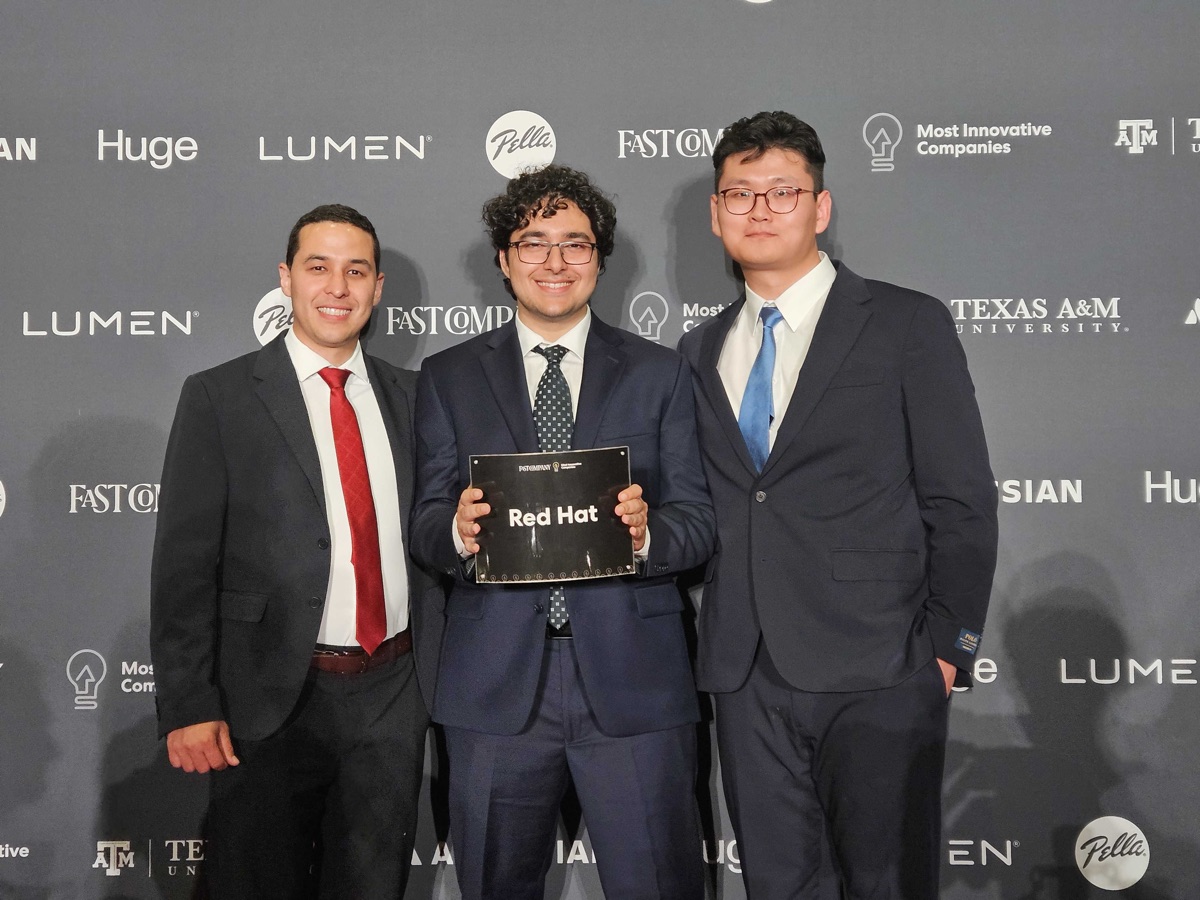
- 2025 Fast Company Most Innovative Companies — Accepted the award on behalf of Red Hat, recognized as the #15 most innovative enterprise company of 2025, with InstructLab cited as the key innovation.
- 2024 IBM Research Accomplishment Award (A-Level) — Named in IBM Research's 2024 Research Accomplishments for founding contributions to InstructLab.
- 2021 Best Paper Award, AAAI 2021 — For "Mitigating Political Bias in Language Models through Reinforced Calibration."
Recent Updates
- 2026 Paper accepted to ICML 2026: "Mitigating Premature Exploitation in Particle-based Monte Carlo for Inference-Time Scaling"
- 2026 Featured in Red Hat Research Quarterly: "Particle filtering for better LLM reasoning: a different approach to inference-time scaling"
- 2025 Paper accepted to NeurIPS 2025: "Inference-Time Scaling of LLMs using Particle-Based Monte Carlo Methods"
- 2025 New preprint: "Dr. SoW: Density Ratio of Strong-over-Weak LLMs for Preference Tuning" on arXiv
- 2025 Paper accepted to ICLR 2025: "Unveiling the Secret Recipe: A Guide for Supervised Fine-Tuning Small LLMs"
- 2024 Paper accepted to ICML 2024: "BRAIn: Bayesian Reward-conditioned Amortized Inference for NLG from Feedback"
- 2024 Paper accepted to ACL 2024 Findings: "A Grounded Preference Model for LLM Alignment"
- 2023 Paper accepted to ACL 2023: "Are Fairy Tales Fair? Analyzing Gender Bias in Temporal Narrative Event Chains"
- 2022 Best Paper Award at AAAI 2021 for work on mitigating political bias in language models
Experience
Principal Research Scientist
Red Hat, Inc. | Boston, MA
November 2024 - Present
- Led design and development of enterprise-grade agent system within IBM's WatsonX Orchestrate. Core contributor and architect for agent evaluation and feedback loop.
- Spearheaded integration of inference-time scaling and reward modeling techniques into production stack, enabling agents to learn from evaluation results and improve through compute scaling and reinforcement learning.
- Led preference training for RHELAI – a flagship AI product for IBM and Red Hat. Invented Dr.SoW, a novel method for automatic preference annotation that significantly reduces human labeling cost.
- Co-invented particle-based sampling algorithm for efficient LLM inference-time compute scaling, achieving state-of-the-art accuracy-compute tradeoffs.
Research Engineer
IBM Research, Thomas J. Watson Research Center | Yorktown Heights, NY
January 2023 - November 2024
- Led development and release of Merlinite-7B-PT, the first preference-aligned LLM from the InstructLab project, achieving alignment performance competitive with GPT-3.5 and Claude-v1 using only 48k AI-generated preference pairs.
- Developed reward modeling techniques with document-grounded feedback to improve faithfulness and reasoning in QA and RAG tasks.
- Co-developed Bayesian framework for preference alignment included in technical reports of Nvidia's Nemotron series and IBM's Granite models.
AI Research Intern
IBM Research, Thomas J. Watson Research Center | Yorktown Heights, NY
June 2022 - September 2022
- Improved training of IBM's SOTA BART-based AMR parser with dynamic MLM and features creation, reducing training time by 20% and memory requirement by 130G.
- Led development of first jointly-trained text and AMR-graph model with novel constrained decoding scheme, approaching SOTA Smatch scores.
Graduate Research Assistant
PLUS Lab, UCLA | Los Angeles, CA
September 2021 - Present
- Led development of NECE (Narrative Event Chain Extraction) toolkit, building first online interactive system dedicated to narrative event chain analysis with 10% performance improvement.
- Proposed first human-reaction based model to evaluate dialogue engagingness, surpassing existing metrics in 4 of 5 benchmarks.
- Applied knowledge distillation and attention head pruning to reduce toxicity-level of GPT2 and Blenderbot, reducing memory by 50% and inference time by 60%.
Selected Projects & Publications
Entropic Particle Filtering for Inference-Time Scaling
Mitigating premature exploitation in particle-based Monte Carlo for inference-time scaling — an entropic particle filtering method that preserves particle diversity and improves LLM reasoning on hard math tasks. First-authored by Giorgio Giannone. (ICML 2026)
Dr. SoW: Preference Tuning
Novel method for automatic preference annotation using density ratio of strong-over-weak LLMs, significantly reducing human labeling costs in LLM alignment. (arXiv 2025)
Inference-Time Scaling via Particle Methods
Particle-based Monte Carlo sampling algorithm for efficient LLM inference-time compute scaling, achieving SOTA accuracy-compute tradeoffs. (NeurIPS 2024)
Merlinite-7B-PT
First preference-aligned LLM from InstructLab project, achieving GPT-3.5 level performance using only 48k AI-generated preference pairs. Released open-source under Apache 2.0.
NECE: Narrative Event Chain Extraction
First online interactive system for narrative event chain analysis, combining BookNLP and AllenNLP with novel algorithms for character extraction and salient event identification.
BRAIn: Bayesian Preference Alignment
Bayesian framework for LLM preference alignment adopted by Nvidia's Nemotron and IBM's Granite models. Reward-conditioned amortized inference for natural language generation. (ICML 2024)
EnDex: Dialogue Engagingness Evaluation
First human-reaction based model for evaluating dialogue engagingness at scale, trained on large Reddit corpus using distant-supervision framework. (EMNLP 2022)
Skills & Technologies
AI/ML Frameworks
PyTorch, Spark, Pandas, Machine Learning, Deep Learning, NLP, LLM Alignment, Reinforcement Learning
Developer Tools
Python, Git, Docker, OpenShift, Cursor, ClaudeCode, SQLite
Research Areas
Inference-Time Scaling, Preference Alignment, Bayesian Inference, Reward Modeling, Dialogue Systems, Knowledge Distillation
Specializations
Large Language Models, Enterprise AI Agents, Post-Training Techniques, Document-Grounded Feedback, RAG Systems
Contact
I'm always interested in new research collaborations and opportunities. Feel free to reach out to discuss AI/ML research, enterprise AI systems, or potential collaborations.
Email: gxu21@cs.ucla.edu
GitHub: @gx-ai-architect
LinkedIn: linkedin.com/in/gxxu
Google Scholar: Publications